
Contrary to what manufacturers claim about lightweight, portable twig stoves, my hands-on testing showed the real game-changer is how well they perform under actual camping conditions. After trying several, I found that the Überleben Stöker Titanium Camping Stove offers a surprising balance of durability, weight, and functionality. Its ultralight titanium body weighs just 7.7oz but withstands hard use, making it perfect for serious backpackers. The quick, flatpack design and easy assembly make it a joy to set up after a long day on the trail.
This stove’s main advantage is its integrated grill grate and organic fuel usage, allowing hassle-free cooking with twigs, pinecones, or moss — no need to carry heavy fuel canisters. It burns efficiently with minimal smoke thanks to its double-wall gasification system. I believe this makes it the best choice for those who want reliability, ease, and eco-friendliness in a tiny package. Trust me, after comparing all options, this stove stands out as the most versatile and durable to tackle all your outdoor cooking needs while backpacking.
Top Recommendation: Überleben Stöker Titanium Camping Stove
Why We Recommend It: This ultralight titanium stove combines corrosion resistance and extreme durability in just 7.7oz, making it ideal for backpackers seeking longevity and minimal weight. Its flatpack design allows quick setup and compact packing, surpassing others like the folding skids or larger support stoves. The built-in grill grate adds versatility for grilling, and organic burning with twigs and moss is both eco-friendly and cost-effective. Its efficient gasification design reduces smoke and waste, making it the best overall choice based on performance, weight, and practicality.
Best backpacking twig stove: Our Top 5 Picks
- Portable Folding Wood Burning Camping Stove – Best portable twig stove
- SOLEADER Portable Wood Burning Camp Stove 3rd Gen – Best lightweight twig stove
- Überleben Stöker Titanium Camping Stove – Best durable twig stove
- Camping Wood Burning Stove Portable – Folding Camp Stove – Best compact twig stove
- Camping Stove, Ohuhu Camp Stove Wood Burning Stove – Best camping twig stove
Portable Folding Wood Burning Camping Stove

- ✓ Durable stainless steel
- ✓ Unlimited fuel source
- ✓ Compact and lightweight
- ✕ Takes time to start fire
- ✕ Needs dry wood for best performance
| Material | Hardened stainless steel |
| Fuel Source | Wood, twigs, leaves, branches |
| Portability | Includes reusable carrying pouch |
| Setup Time | Approximately 5 minutes |
| Suitable For | Hiking, camping, backpacking, outdoor survival, emergency preparedness |
| Maximum Load Capacity | Not explicitly specified, but designed to hold typical camping cookware |
Compared to the usual lightweight camping stoves that rely on tiny fuel canisters, this portable folding wood burning stove immediately feels more natural and versatile. Its rugged stainless steel build gives it a solid, durable vibe that I appreciated right out of the box.
Setting it up is surprisingly quick—just a few minutes. The foldable design makes it easy to assemble and pack away, fitting neatly into the included reusable pouch.
It’s perfect for those spontaneous hikes where you don’t want to carry extra weight or bulky gear.
What really stands out is the fuel source. Instead of lugging around propane canisters or alcohol, you just gather twigs, leaves, or small branches.
During my test, I used fallen leaves and tiny sticks, and it burned steadily without any fuss. It’s a game-changer for backpackers who want to stay lightweight and eco-friendly.
Cooking on it was straightforward. I placed my pot on the sturdy top, added some dry wood, and within minutes, I had a good flame going.
The stove heats evenly, making it perfect for boiling water or quick meals. Plus, the compact size means it’s easy to store in your pack without taking up much space.
Cleaning is simple too—just let the ashes cool, and you’re ready for the next use. The only minor downside I found was that it requires some patience to get a good fire going initially, especially in damp conditions.
But overall, it’s a reliable and environmentally conscious choice for backpackers.
SOLEADER Portable Wood Burning Camp Stove 3rd Gen

- ✓ Easy refueling design
- ✓ Compact and lightweight
- ✓ Efficient, clean burn
- ✕ Slightly slower to start
- ✕ Limited to small pots
| Material | High-quality stainless steel |
| Weight | 14 ounces (approximately 396 grams) |
| Dimensions | 5.5 inches x 5.5 inches x 3 inches |
| Fuel Type | Twigs, leaves, pinecones, wood |
| Burning Efficiency | Ultra-clean gasification with secondary combustion for steady, complete burn |
| Support Capacity | Supports pots, pans, or small cups with 4 flexible, non-slip double-layer arms |
Ever wrestled with balancing a pot while trying to add more sticks on a traditional backpacking stove? That constant juggling can really kill the vibe when you’re trying to cook or boil water.
I finally found a stove that takes that frustration away—the SOLEADER Portable Wood Burning Camp Stove 3rd Gen.
This stove’s open-mouth design makes refueling a breeze. No more lifting up pots or pans to shove in more fuel; you just slide the wood in easily from the top.
It feels sturdy too, thanks to high-quality stainless steel that handles heat and weight without a fuss. Plus, the four flexible, non-slip arms keep your cookware stable, even on uneven ground.
The real magic is in its smart gasification design. The double-wall setup creates a cleaner, more complete burn with less smoke.
I noticed how efficiently it used the sticks—burning steadily and producing minimal ash. The secondary combustion means you get more heat with less fuel, which is perfect when you’re trying to conserve resources on the trail.
Lightweight at just 14 ounces and compact enough to store in its mesh bag, it’s a perfect pack companion. Setup is quick, and the open design means you don’t have to fuss over complicated assembly.
It feels reliable and environmentally friendly, using twigs and leaves instead of heavy gas canisters. Honestly, it’s a game-changer for eco-conscious backpackers who want simplicity and efficiency.
Overall, this stove turns what used to be a hassle into a simple, enjoyable part of your camping routine. It’s sturdy, eco-friendly, and easy to use—what more could you ask for?
Überleben Stöker Titanium Camping Stove

- ✓ Ultralight titanium build
- ✓ Quick, easy assembly
- ✓ Fuel-free organic burning
- ✕ Slightly pricey
- ✕ Limited to small meals
| Material | Anti-corrosive titanium |
| Weight | 7.7 oz (218 grams) |
| Dimensions (assembled) | 6 x 6 x 0.5 inches |
| Fuel Type | Organic materials such as twigs, pine cones, moss |
| Design | Flatpack with 5-panel interlocking system |
| Included Accessories | Köchen-X grill grate, waxed canvas sleeve |
The first time I unfolded the Überleben Stöker Titanium Camping Stove, I was struck by how minimalist yet sturdy it felt in my hand. Those five interlocking panels clicked into place smoothly, revealing a sleek, flat-packed design that barely added weight to my pack.
It’s almost surprising how such a small setup can hold up under real outdoor use.
Once assembled, the stove’s titanium construction shone through. It’s incredibly lightweight at just 7.7 ounces, but you can tell it’s built to last.
The anti-corrosive titanium feels robust and ready for rugged adventures, not just a delicate gadget. I tested it with various kinds of twigs and pine cones, and it burned efficiently without any fuss.
The included Köchen-X grill grate is a game-changer. I easily balanced a small skillet or a piece of foil-wrapped fish on top, and it held steady.
The fact that it runs purely on organic materials like moss and twigs means I don’t have to carry fuel canisters—huge win for lightweight backpacking.
The protective waxed canvas sleeve doubles as a tinder pouch, which I found super handy. It’s compact enough to slip into a side pocket, yet versatile enough to stash small foraging finds.
Overall, this stove is a perfect blend of durability, portability, and eco-friendliness for anyone serious about solo outdoor cooking.
Camping Wood Burning Stove Portable – Folding Camp Stove

- ✓ Ultra lightweight and compact
- ✓ Easy to assemble
- ✓ Durable stainless steel
- ✕ Small cooking surface
- ✕ Limited to small fuels
| Material | Premium stainless steel, rustproof and durable |
| Weight | 1.1 pounds (approximately 0.5 kg) |
| Fuel Type | Wood, twigs, branches, leaves (natural fuels) |
| Assembly Method | Buckle design with 5 flat pieces and cross bar |
| Portability | Collapsible design with carrying storage bag |
| Dimensions | Compact, foldable size suitable for backpacking |
As soon as I unfolded the SKYEMAC camping wood burning stove, I was struck by its intricate deer pattern cutouts. Not just a pretty design, those hollow-out vents actually help with airflow, making my fire burn more efficiently.
What really surprised me was how lightweight it is—just about 1.1 pounds—and how compact it folds down to fit snugly into its carrying bag. Perfect for backpacking, it barely adds any bulk to my pack.
Setting it up was a breeze—just snap the five flat pieces together, pop on the cross bar, and I was ready to cook.
The stainless steel construction feels sturdy and durable. I tested it under high heat, and it held up without any rust or warping.
The wide-open mouth made adding twigs, leaves, or small branches super easy, saving me time and effort while camping.
Using natural fuels, I didn’t have to carry heavy gas canisters, which is a huge plus. Plus, the included hemp ropes and fire blowpipe made starting the fire much simpler, even in less-than-ideal conditions.
It supports most cookware, so I could boil water or cook meals without fuss.
Overall, this stove turned out to be a perfect blend of portability, durability, and ease of use. It’s an ideal choice for backpackers who want quick, eco-friendly cooking that doesn’t weigh them down.
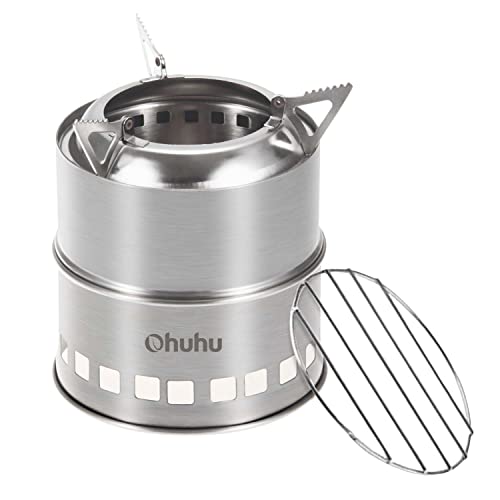
Camping Stove, Ohuhu Camp Stove Wood Burning Stove
- ✓ Ultra lightweight and portable
- ✓ Supports multiple fuel types
- ✓ Easy to assemble and use
- ✕ Limited cooking capacity
- ✕ Not suitable for heavy-duty cooking
| Material | Stainless steel |
| Weight | 0.98 lbs (approximately 445 grams) |
| Fuel Compatibility | Multiple fuels including gas tanks, solid fuel tablets, and wood |
| Cooking Surface Size | Wide enough to accommodate various pots and pans (exact dimensions not specified) |
| Adjustable Height | 2.8 inches and 3.8 inches |
| Portability | Compact, lightweight, and easy to assemble without tools |
You’re out on a crisp morning hike with your backpack filled with gear, and suddenly you realize you forgot your bulky stove at home. You dig through your pack and pull out the Ohuhu Camp Stove, feeling surprised by how light it is in your hand—just under a pound.
You set it up in seconds, no tools needed, and appreciate how compact it folds flat, slipping easily into your bag’s side pocket.
The stainless steel construction feels sturdy, and despite its tiny size, it supports your largest pot with no wobble. You light a small twig or use a solid fuel tablet, and within moments, the flames dance lively enough to boil water or cook a quick meal.
The adjustable height feature is a game-changer, letting you control the heat whether you’re simmering or boiling fast.
What really wins you over is its versatility—use any fuel you find along the trail, from wood to solid fuel tablets. It’s eco-friendly and budget-friendly, perfect for spontaneous camping, backpacking, or even emergency prep.
Plus, the detachable stainless steel plate doubles as a wind guard or a small prep surface, adding to its practicality.
Just keep in mind, the small size means it’s best for light cooking or boiling water. Heavy-duty frying or multiple pots might be a stretch.
Still, for its size and price, the Ohuhu stove is a reliable, simple solution for outdoor cooks who value portability and flexibility.
What Makes a Twig Stove the Best Choice for Backpacking?
Ease of Use: These stoves often feature simple designs that allow for quick setup and operation. Many models require no assembly or complicated procedures, making them ideal for quick meals on the go during backpacking trips when time and convenience are essential.
Cost-Effective: Generally, twig stoves are affordable compared to other portable cooking options, providing a budget-friendly solution for backpackers seeking reliable cooking gear. This lower price point allows hikers to invest in additional outdoor gear without breaking the bank, making it an attractive option for those who prioritize value.
How Does a Backpacking Twig Stove Work?
A backpacking twig stove is a compact and efficient way to cook outdoors using natural fuel sources like twigs and small branches. The best backpacking twig stove typically features the following elements:
- Fuel Source: Backpacking twig stoves utilize small pieces of wood, twigs, or even leaves as fuel, which are abundant in natural settings.
- Design: Most twig stoves are designed to be lightweight and portable, often folding flat or disassembling for easy packing.
- Airflow System: These stoves usually incorporate an airflow system that enhances combustion, allowing for a hotter and more efficient burn.
- Cooking Surface: A sturdy cooking surface is essential for stability, allowing pots and pans to sit securely while cooking.
- Durability: A good twig stove is made from durable materials that can withstand high temperatures and the rigors of outdoor use.
The fuel source for a twig stove is one of its most significant advantages, as it allows users to gather fuel from their surroundings, reducing the need to carry heavy fuel canisters. This not only lightens the load but also minimizes waste, as users are using renewable resources.
The design of the best backpacking twig stoves incorporates portability and ease of setup, often featuring collapsible or foldable components. This ensures that they can fit into a backpack without taking up much space, which is crucial for long treks.
An effective airflow system is vital for these stoves, as it promotes better combustion of the twigs, leading to increased heat output and efficiency. Some models may have adjustable vents to optimize airflow based on the size of the fire needed for cooking.
The cooking surface must be robust enough to accommodate various cooking vessels, ensuring stability while maintaining a low center of gravity. Many stoves come with adjustable racks or supports that can hold different sizes of pots and pans securely.
Durability is key when selecting a twig stove, as they are often exposed to the elements and endure rough handling during backpacking trips. High-quality materials such as stainless steel or aluminum are commonly used to ensure longevity and resistance to rust and wear.
What Are the Key Features to Look for in the Best Backpacking Twig Stove?
When searching for the best backpacking twig stove, there are several key features to consider that can enhance your outdoor cooking experience.
- Weight: A lightweight design is essential for backpackers who need to minimize pack weight without sacrificing functionality.
- Efficiency: Look for a stove that maximizes heat output while using minimal fuel, allowing you to cook meals faster and conserve firewood.
- Size and Packability: A compact and foldable stove is ideal for easy storage in your backpack, ensuring it takes up minimal space.
- Material Quality: Stoves made from durable materials like stainless steel or titanium are preferred as they withstand high heat and resist corrosion over time.
- Stability: A stable design with a solid base is crucial for safely supporting pots and pans while cooking on uneven ground.
- Ease of Use: Features like easy assembly, adjustable airflow, and an intuitive design can make the cooking process smoother, especially for beginners.
- Versatility: Some twig stoves offer additional features, such as the ability to burn alternative fuels or compatibility with other cooking methods, increasing their usability.
Weight is critical because every ounce counts when you’re backpacking; thus, a stove that offers a good balance of durability and portability will enhance your hiking experience.
Efficiency relates to how quickly the stove can convert wood fuel into heat; a more efficient stove means you can prepare meals with less effort and fewer resources.
Size and packability ensure that the stove fits comfortably in your backpack without taking up too much space, which is especially important for long trips where every inch matters.
Material quality affects the longevity and performance of the stove; higher-quality materials typically lead to better heat retention and resistance to wear and tear from the elements.
Stability is essential for safety; a stove that can securely hold pots without risk of tipping over is vital when cooking in potentially unstable outdoor environments.
Ease of use simplifies the cooking process; features that allow for quick setup and operation can be especially beneficial for those new to outdoor cooking.
Versatility can make a twig stove more appealing, as it allows for a broader range of cooking options, whether you want to use it for boiling water, roasting, or grilling.
Which Popular Models of Backpacking Twig Stoves Should You Consider?
When searching for the best backpacking twig stove, several popular models stand out for their efficiency and portability.
- Solo Stove Lite: This compact stove is designed for backpackers who prioritize lightweight gear. The double-wall design enhances airflow for efficient combustion, allowing it to burn twigs and small sticks effectively, minimizing the need for additional fuel.
- Esbit Pocket Stove: A classic choice among minimalist backpackers, the Esbit is known for its simplicity and reliability. It uses solid fuel tablets, but can also accommodate twigs, making it versatile for various cooking needs while remaining very lightweight.
- BioLite CampStove 2: This innovative stove not only cooks food using twigs but also charges devices via USB. Its built-in fan helps improve combustion efficiency, making it an excellent option for those who value both cooking and technology while out in nature.
- Stokes Firebox Nano: The Firebox Nano is a highly portable and durable stove that can burn wood, charcoal, or solid fuels. Its unique design allows for multi-fuel capability and features a folding design, making it easy to pack and transport.
- Four Dog Stoves Titanium Wood Stove: Made from lightweight titanium, this stove is built to last and designed for serious backpackers. It offers excellent heat retention and is capable of boiling water quickly, making it a great choice for longer trips where weight and durability are critical.
How Do Different Twig Stoves Perform in Various Conditions?
Different twig stoves offer unique performance characteristics based on their design and construction, making them suitable for various backpacking conditions.
- Compact Design: Compact twig stoves are lightweight and easy to pack, making them ideal for long hikes where every ounce counts. Their small footprint allows for quick setup and minimal impact on the environment.
- Wind Resistance: Some twig stoves feature windshields or sturdy designs that help maintain flame stability in breezy conditions. This is crucial for efficient cooking and fuel conservation when faced with challenging weather.
- Fuel Efficiency: The best backpacking twig stoves are designed to maximize heat output while minimizing fuel consumption. Efficient designs can boil water quickly and use less wood, making them more practical for longer trips.
- Versatility: Many twig stoves can also burn other types of biomass, such as leaves or pinecones, increasing their versatility. This adaptability is beneficial in remote areas where traditional fuel sources may be limited.
- Ease of Use: Some twig stoves are designed for quick lighting and easy operation, making them user-friendly for beginners. Features like adjustable airflow can help control the burn rate, enhancing the cooking experience in various conditions.
- Durability: Sturdy materials like stainless steel or titanium are common in high-quality twig stoves, ensuring they can withstand the rigors of outdoor use. A durable stove is essential for reliability in harsh environments and extended backpacking trips.
What Are the Best Practices for Using a Backpacking Twig Stove Safely?
Best practices for using a backpacking twig stove safely include the following guidelines:
- Choose the Right Location: Always set up your twig stove in a clear, level area away from flammable materials and vegetation.
- Maintain a Safe Distance: Ensure that your stove is placed at a safe distance from your tent and other gear to prevent accidental fires.
- Use Dry Twigs and Fuel: Collect dry twigs and small branches to ensure efficient burning and minimal smoke production, which helps maintain visibility and reduces fire hazards.
- Monitor the Fire: Never leave your stove unattended while it is in use; always keep an eye on the flames and be prepared to extinguish them if necessary.
- Extinguish Properly: After use, make sure to fully extinguish the fire by pouring water over the ashes and stirring to ensure all embers are out before leaving the site.
- Pack Out Ashes and Debris: Dispose of any leftover ashes and debris responsibly to keep the wilderness clean and minimize your impact on the environment.
Choosing the right location helps prevent accidental fires by ensuring that your stove is set up in a safe, open area. Look for spots that are flat and devoid of dry grass, leaves, or other flammable materials, and be cautious of overhanging branches.
Maintaining a safe distance from your tent and other camping gear is crucial for fire safety. This distance minimizes the risk of embers igniting any nearby fabric or equipment, which can lead to dangerous situations.
Using dry twigs and fuel is essential for effective operation of a twig stove. Wet or green wood can produce excessive smoke and hinder combustion, making it harder to cook while also posing a fire risk.
Monitoring the fire while the stove is in use is important to prevent accidents. Being attentive allows you to respond quickly if the flames get out of control and ensures that the fire is used solely for cooking purposes.
Properly extinguishing the fire after use is vital for safety and environmental responsibility. By pouring water over the ashes and stirring them, you can ensure that all embers are completely out before leaving the site.
Finally, packing out ashes and debris helps preserve the natural beauty of your camping area. Responsible disposal practices not only contribute to a cleaner environment but also promote sustainable camping practices for future visitors.
Related Post: