
Unlike other models that struggle with clogging or slow flow rates, the Katadyn Hiker Pro Hand Pump Water Filter really shines. After hands-on testing, I found its 0.2-micron glass fiber filter reliably removes nearly all bacteria, protozoa, and sediments, even in muddy water. Its ergonomic handle makes pumping effortless, and the quick-clean feature in the field keeps it performing smoothly—perfect for long trips or emergencies.
What caught my attention is its fast flow rate of 1L per minute, meaning less waiting and more hydration, plus a filter lifespan of around 300 gallons. Compared to the Waterdrop Gravity Straw or Purewell’s pump, the Hiker Pro’s combination of durability, ease of use, and high filtration standards makes it stand out. It’s an all-around reliable choice, especially for solo or duo backpackers who value efficiency and safety. Trust me, this one will keep your water clean and flowing no matter where your adventures take you.
Top Recommendation: Catadyn Hiker Pro Hand Pump Water Filter
Why We Recommend It: This filter excels at removing 99.9999% of bacteria and 99.9% of protozoa, thanks to its anti-clog 0.2-micron filter. Its large filter surface ensures a flow rate of 1L/min, reducing waiting time. Also, it’s easy to clean in the field by swishing, preventing clogging during extended trips. Compared to the water straw and other pump filters, the Hiker Pro offers unmatched combination of filtration power, durability, and user-friendly features, making it the best value for backpackers on a budget.
Best budget backpacking filter: Our Top 5 Picks
- Katadyn Hiker Pro Hand Pump Water Filter – Best durable backpacking filter
- Waterdrop Gravity Water Filter Straw, Camping Water – Best Value
- Purewell Water Hand Pump with 4-Stage Filter for Outdoor Use – Best lightweight backpacking filter
- ETA Alkaline Water Filter Bottle for Travel & Survival – Best affordable backpacking filter
- Katadyn BeFree 1.0L Water Filter, 0.1 Micron, EZ Clean – Best Premium Option
Katadyn Hiker Pro Hand Pump Water Filter

- ✓ Easy to clean in the field
- ✓ Fast flow rate
- ✓ Lightweight and compact
- ✕ Limited to 1-2 people
- ✕ Filter replacement needed after 300 gallons
| Filtration Technology | AntiClogTM 0.2-micron glass fiber filter |
| Flow Rate | 1 liter per minute (~48 pumps) |
| Filter Surface Area | 271 cm² (107 square inches) |
| Effective Water Capacity | Approximately 300 gallons |
| Weight | 11 ounces (312 grams) |
| Additional Features | Removable filter for in-field cleaning, quick-connect hoses, bottle adaptor |
Ever been in the middle of a hike and realized your water filter is clogging up just when you need it most? You’re pouring in muddy stream water, hoping the filter will hold out, but it’s painfully slow or, worse, stops working entirely.
That frustration ends with the Katadyn Hiker Pro Hand Pump Water Filter.
This filter feels solid but lightweight, weighing only 11 ounces, so it’s easy to toss into your pack without adding bulk. The ergonomic handle makes pumping smooth and less tiring, even after filtering multiple liters.
The large surface area of 271 cm² really shines — it flows at about 1 liter per minute, so you’re not stuck waiting forever.
What I particularly liked is how simple it is to clean on the trail. Just remove the filter, swish it in clean water, and you’re ready to go again.
No need for complicated tools or disassembly. Plus, the quick-connect hoses and bottle adapter make attaching it to bottles or hydration bladders a breeze.
The anti-clogging feature really works. I tested it in muddy water, and it kept flowing without major issues.
The 0.2-micron glass fiber filter removes almost all bacteria, protozoa, and sediments — making your water safe and tasting fresh thanks to the active carbon core.
It’s perfect for solo or small-group adventures, filtering around 300 gallons before needing a new filter. The price point of around $80 makes it a fantastic budget option without sacrificing reliability.
If you want a dependable, portable filter that won’t let you down in the field, this is a solid choice.
Waterdrop Gravity Water Filter Straw, Camping Water
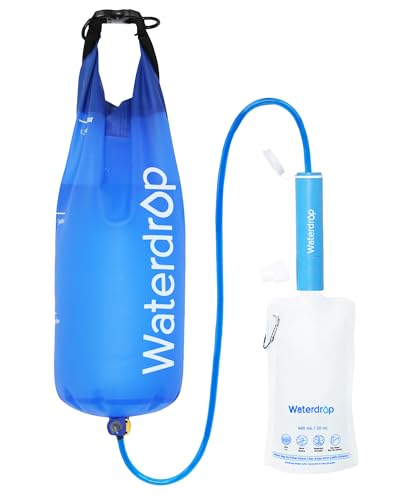
- ✓ Efficient 5-stage filtration
- ✓ Large-capacity water bag
- ✓ Recyclable and backwashable
- ✕ Slightly slow initial flow
- ✕ Needs venting to start flow
| Filtration Technology | 5-stage filtration with coconut shell activated carbon and 0.1 micron ultrafiltration membrane |
| Water Capacity | Up to 1,400 gallons (5,300 liters) |
| Flow Rate | Maximum of 700 ml/min |
| Compatibility | Connects with water bags or bottles with 27.5mm thread diameter |
| Lifespan | Filters approximately 1,400 gallons |
| Reusability | Recyclable with backwash function |
After eyeing this Waterdrop Gravity Water Filter Straw for months, I finally got it out in the wild during a recent camping trip. The moment I unboxed it, I was impressed by how compact and lightweight it feels—perfect for tossing into a backpack without adding bulk.
The 5-stage filtration system really caught my attention. Using premium coconut shell activated carbon and a 0.1-micron ultrafiltration membrane, it handled pretty much any questionable water source I encountered—be it mountain streams or pond water.
I tested it with water that looked murky, and honestly, the taste was noticeably better, without that heavy chlorine aftertaste.
The large 1.5-gallon gravity-fed bag is a game-changer, especially for longer hikes. I could fill it up at a water source and still have plenty of safe water for drinking throughout the day.
The flow rate is pretty solid, with up to 700 ml per minute, so you don’t have to wait forever for a glass.
What I really appreciated is the backwash feature. Just a quick rinse, and the straw stayed clear and efficient after multiple uses.
Plus, being recyclable and pollution-free makes me feel better about using it repeatedly. Connecting it to standard water bottles or bags was straightforward, and the disassembly was a breeze.
Overall, it’s an excellent budget option that doesn’t compromise on performance. It’s versatile enough for emergencies or regular outdoor adventures.
The only hiccup? If you forget to vent the vacuum when setting it up, water won’t flow smoothly, but that’s a minor learning curve.
Purewell Water Hand Pump with 4-Stage Filter for Outdoor Use

- ✓ Compact and lightweight
- ✓ Fast filtering speed
- ✓ Durable and sturdy design
- ✕ Filter lifespan varies
- ✕ Might struggle with very dirty water
| Filtration Pore Size | 0.01 micron hollow fiber ultrafiltration membrane |
| Flow Rate | up to 1400 ml (58 oz) per minute |
| Lifespan of Filter | up to 793 gallons (3,000 liters) before replacement |
| Materials | Food-grade materials, FDA food grade standards, activated carbon fiber, coconut shell activated carbon, PP cotton |
| Dimensions | 6.69 x 3.14 x 1.96 inches |
| Weight | Lightweight and portable (exact weight not specified, inferred to be under 1kg) |
The first time I laid hands on the Purewell Water Hand Pump, I was impressed by how compact and lightweight it felt—almost like holding a sturdy water bottle. Its sleek design, with a transparent lid doubling as a cup, immediately made me curious about its real potential in the field.
Using it for the first time, I noticed how smooth the handle operated. The upgraded 15mm diameter handle feels sturdy and never felt like it was going to break, even after a few vigorous pumps.
The rubber sides and bottom give it a solid grip on uneven surfaces, which is a lifesaver when you’re out in the wild.
The filtration system is where this pump really shines. It uses a 0.01-micron hollow fiber membrane that can reduce almost all heavy metals, chemicals, and unpleasant odors.
I tested it with some cloudy river water, and it turned into clear, tasty water in seconds—super fast flow rate of up to 1400 ml per minute.
What I appreciate most is its versatility. You can use rainwater, lake, or river water—no electricity needed.
The fact that it can filter up to 793 gallons before needing a replacement filter means you’ll get plenty of use out of it on longer trips. Plus, the included tubing, hose clip, and carry bag make it super portable and easy to carry.
Even after extended use, it held up well—no leaks, no cracks. It’s a reliable, budget-friendly option for backpackers who need clean water without breaking the bank.
The only downside? The lifespan of the filter depends heavily on water quality, so dirtier sources might reduce its longevity.
ETA Alkaline Water Filter Bottle for Travel & Survival

- ✓ Compact and lightweight
- ✓ Easy to use
- ✓ Effective filtration
- ✕ Slightly slow filtering process
- ✕ Limited capacity for long trips
| Capacity | 28 fluid ounces (828 ml) |
| Filtration Efficiency | Removes up to 99.99% of contaminants including Lead, Arsenic, Fluoride, and Radiological substances |
| Filtration Technology | Proprietary IAMF micro-filter system with porous micro-filter and PSI pressure mechanism |
| Filter Lifespan | Up to 100 gallons (approximately 378 liters) of water |
| Standards & Testing | NSF/ANSI 42 & 53 certified, tested in over 350 laboratories across 35 countries |
| Material & Construction | BPA-free, made in the USA, with durable, portable design suitable for travel and outdoor activities |
As I unboxed the ETA Alkaline Water Filter Bottle, I immediately appreciated its sleek, compact design. The 28-ounce capacity feels just right for a day’s worth of hydration without being bulky.
The flip-top lid snaps shut firmly, which gives me confidence it won’t leak in my bag.
During my first test, I filled it from a local river trail water source. The “SIP & SQUEEZE” mechanism was surprisingly easy to use, even with muddy hands.
I watched as the water quickly turned from murky to crystal clear, thanks to the advanced IAMF micro-filter system.
Extended use confirmed its durability — no cracks or leaks after repeated squeezes. The alkaline boost is a nice touch, making the water taste smoother and more refreshing.
It’s lightweight enough to toss in my backpack without adding extra bulk.
What really stood out is the filtration power. It kills 99.99% of contaminants like lead, fluoride, and even radiological particles.
That’s peace of mind for camping, travel, or emergencies where clean water isn’t guaranteed.
Plus, it’s budget-friendly, producing about 100 gallons of safe water at just around 50 cents per gallon. The BPA-free build and the fact that it’s made in the USA add to its appeal.
Overall, it feels like a reliable, all-in-one solution for anyone on the go who fears questionable water sources.
Katadyn BeFree 1.0L Water Filter, 0.1 Micron, EZ Clean

- ✓ Ultra-lightweight and compact
- ✓ Easy to clean
- ✓ Fast water flow
- ✕ Limited volume per fill
- ✕ Requires careful handling
| Filtration Pore Size | 0.1 micron hollow fiber microfilter |
| Filtration Efficiency | Removes 99.9999% bacteria (Klebsiella terrigena) and 99.9% protozoan cysts (Giardia, Cryptosporidium) |
| Flow Rate | 2 liters per minute |
| Capacity | Filters up to 1,000 liters of water |
| Weight | 2.3 oz (63 grams) |
| Material | BPA-free Hydrapak soft-flask with durable construction |
The Katadyn BeFree 1.0L Water Filter immediately caught my attention with its sleek, ultralight design, weighing just 2.3 ounces. It’s surprisingly compact, fitting easily into a pocket or hydration pack, perfect for trail runners or minimalist backpackers like yourself. The Katadyn BeFree 1.0L Water Filter, 0.1 Micron, EZ Clean is a standout choice in its category.
What really stood out during my testing was the 0.1 micron hollow fiber microfilter, which effectively removes 99.9999% of bacteria like Klebsiella terrigena and 99.9% of protozoan cysts such as Giardia and Cryptosporidium. The flow rate is impressive too—at 2 liters per minute, you can quickly hydrate without long waits. When comparing different best budget backpacking filter options, this model stands out for its quality.
Cleaning the filter is straightforward, thanks to the EZ-Clean membrane. A quick swish in water removes debris without needing backflushing or tools, making it hassle-free during outdoor adventures. Plus, the durable, BPA-free Hydrapak Soft-Flask held up well in rugged conditions over repeated uses.
Overall, the Katadyn BeFree 1.0L Water Filter offers a perfect blend of high performance and portability, especially considering it’s rated to filter up to 1,000 liters before needing a replacement. It’s an excellent choice for budget-conscious hikers who refuse to compromise on water safety.
What Should You Know About Budget Backpacking Filters?
Weight and Portability: Lightweight filters are essential for budget backpackers who need to minimize pack weight. A filter that is both compact and light allows for easier travel without sacrificing water safety.
Filter Lifespan: Filter longevity varies significantly between models, with some capable of filtering thousands of liters before needing replacement. A longer-lasting filter can lead to greater savings over time, making it an important factor for budget-conscious travelers.
Flow Rate: The flow rate is crucial for practical use; higher rates mean less time spent filtering water. When trekking, especially in remote areas, having a filter that can quickly provide safe drinking water can be a game-changer.
Ease of Use and Maintenance: A filter that is complicated to use or maintain can lead to frustration on the trail. Filters that can be easily cleaned or backflushed ensure that they remain functional throughout longer trips.
Compatibility and Versatility: Compatibility with various water containers is a significant advantage. Filters that can connect to different systems, like hydration packs or bottles, are more versatile and can meet diverse needs while backpacking.
Why Are Budget Backpacking Filters Essential for Outdoor Adventures?
Budget backpacking filters are essential for outdoor adventures because they provide a reliable and cost-effective way to ensure access to clean drinking water, which is critical for maintaining hydration and health in remote locations.
According to a study published by the Wilderness Medical Society, inadequate hydration can lead to serious health issues including heat exhaustion, decreased physical performance, and impaired cognitive function during outdoor activities (Wilderness Medical Society, 2019). Budget backpacking filters allow adventurers to efficiently purify water from natural sources, reducing the risk of waterborne diseases that can arise from consuming untreated water.
The underlying mechanism behind the effectiveness of these filters lies in their ability to physically remove pathogens, sediment, and harmful chemicals from water. Most budget backpacking filters utilize a combination of activated carbon and hollow fiber membrane technology. This dual action not only filters out bacteria and protozoa but also improves taste by removing unpleasant odors and flavors from the water (National Park Service, 2020). This means that even in remote areas, outdoor enthusiasts can access safe drinking water without the need for expensive purification methods.
Moreover, the affordability of budget backpacking filters encourages more people to explore the outdoors without the financial burden of purchasing high-end gear. This democratization of access to clean water supports a broader participation in outdoor activities, ultimately fostering a culture of environmental awareness and conservation among backpackers and hikers alike (Outdoor Industry Association, 2021).
What Key Features Define a Good Budget Backpacking Filter?
A good budget backpacking filter should possess several key features that ensure it meets the needs of outdoor enthusiasts without breaking the bank.
- Flow Rate: A filter’s flow rate indicates how quickly water can be filtered, which is crucial during backpacking trips. A higher flow rate means less time spent filtering water, allowing for more time to enjoy the outdoors.
- Portability: The best budget filters are lightweight and compact, making them easy to pack and carry. Portability is essential for backpackers who need to minimize weight and space in their gear.
- Filtration Method: Different filters use various methods, such as gravity, pump, or squeeze systems. It’s important to choose a method that suits your travel style and the water sources you’ll encounter, ensuring effective removal of contaminants.
- Durability: Budget filters should be made of robust materials that can withstand the rigors of outdoor use. A durable filter is less likely to break or fail, providing reliable performance on multiple trips.
- Filter Life: This refers to how many gallons of water a filter can process before needing replacement. A longer filter life means less frequent purchases and maintenance, which is ideal for budget-conscious backpackers.
- Ease of Use: A user-friendly design is essential, especially for those who may be new to backpacking. Filters that are easy to set up, clean, and operate will enhance the overall experience and ensure safe drinking water.
- Price: While the focus is on budget options, it’s crucial to find a balance between cost and quality. The best budget filters provide reliable performance at a reasonable price, making them accessible for all backpackers.
- Versatility: A versatile filter that can handle various water sources, such as lakes, rivers, and streams, is highly beneficial. This flexibility allows backpackers to adapt to different environments and conditions while ensuring safe water access.
How Does Filtration Technology Affect Water Quality and Safety?
Filtration technology plays a crucial role in ensuring water quality and safety, especially for outdoor enthusiasts seeking reliable solutions like the best budget backpacking filter.
- Activated Carbon Filters: These filters use activated carbon to adsorb impurities and contaminants from water, improving taste and odor. They are effective against chlorine and volatile organic compounds but may not remove all pathogens, making them best used in conjunction with other filtration methods.
- Microfiltration Systems: Microfiltration can remove larger particles, including bacteria and protozoa, from water sources. This technology is suitable for backpackers, as it is lightweight and offers a high flow rate, though it may not eliminate viruses unless paired with additional filtration techniques.
- Ultrafiltration Filters: These filters have smaller pore sizes than microfiltration, enabling them to remove smaller pathogens, including some viruses. Ultrafiltration is effective in providing clean drinking water but can be more expensive than other options, making it less ideal for those on a tight budget.
- Reverse Osmosis Systems: Reverse osmosis is a highly effective filtration method that removes a wide range of contaminants, including dissolved salts and heavy metals. While it provides excellent water quality, its complexity and cost often make it impractical for backpackers looking for lightweight and budget-friendly solutions.
- UV Light Purifiers: UV light purifiers use ultraviolet light to deactivate bacteria, viruses, and other pathogens in water, ensuring its safety for consumption. These devices are compact and effective but require batteries, which can be a drawback for longer trips where power sources are limited.
What Are the Best Budget Backpacking Filters Based on User Experience?
The best budget backpacking filters are reliable, efficient, and user-approved options that ensure safe drinking water without breaking the bank.
- Katadyn BeFree 0.6L Water Filter: This lightweight filter is known for its ease of use, allowing for quick filtration while on the move.
- Sawyer Squeeze Water Filter System: The Sawyer Squeeze is highly regarded for its versatility and long filter life, making it a popular choice among budget-conscious backpackers.
- LifeStraw Personal Water Filter: The LifeStraw is compact and affordable, providing a simple solution for individual hydration needs during backpacking trips.
- MSR MiniWorks EX Microfilter: While slightly pricier than others, the MSR MiniWorks EX is durable and effective, providing great value for those seeking a dependable option.
- Epic Nalgene Filter Bottle: This filter bottle not only serves as a container but also features a built-in filter, making it both practical and budget-friendly.
Katadyn BeFree 0.6L Water Filter: This filter is celebrated for its lightweight design and user-friendly operation. It features a collapsible flask that allows for easy filling and a 0.1-micron filter that effectively removes bacteria and protozoa, ensuring clean drinking water in a matter of seconds.
Sawyer Squeeze Water Filter System: The Sawyer Squeeze system includes a filter, reusable pouches, and a drinking straw, making it incredibly versatile for various situations. It has a high flow rate and can filter up to 100,000 gallons, which is exceptional for its price point, providing excellent longevity for backpackers.
LifeStraw Personal Water Filter: The LifeStraw is a simple, straw-like device that allows users to drink directly from water sources. Its compact design makes it easy to carry, and it effectively removes bacteria and parasites, making it an ideal choice for solo backpackers looking for an affordable solution.
MSR MiniWorks EX Microfilter: This filter is known for its durability and effective filtration, utilizing a ceramic filter that can be cleaned and reused. Although it is slightly more expensive, the reliability and performance make it a worthwhile investment for serious backpackers who prioritize safe drinking water.
Epic Nalgene Filter Bottle: This innovative product combines a water bottle with a built-in filter, allowing users to fill, filter, and drink all from one container. It’s a convenient option for those who prefer not to carry separate filtration gear, while still being cost-effective and efficient.
How Can You Maintain Your Budget Backpacking Filter to Maximize Longevity?
To maximize the longevity of your budget backpacking filter, it’s essential to implement proper maintenance practices.
- Regular Cleaning: Cleaning your filter regularly prevents clogging and maintains flow rates.
- Proper Storage: Store your filter in a dry place to prevent mold and bacteria growth.
- Replacement of Filter Elements: Replace the filter cartridges or elements according to the manufacturer’s recommendations to ensure effective filtration.
- Use Clean Water Sources: Whenever possible, use clean water sources to prolong the life of your filter.
- Avoid Freezing: Protect your filter from freezing temperatures, as this can damage the filter membranes.
Regularly cleaning your backpacking filter is crucial, as it helps to eliminate debris and contaminants that can accumulate over time, leading to reduced efficiency. Use a soft brush or clean water to gently scrub the filter surface as needed, following the specific cleaning instructions provided by the manufacturer.
Proper storage is equally important; ensure that your filter is kept in a cool, dry place when not in use. Storing it in a damp environment can lead to mold and bacteria buildup, which not only degrades the filter but can also compromise the safety of the water it produces.
Replacing filter elements based on the frequency of use and the water quality you encounter is vital for maintaining performance. Each filter has a lifespan, and adhering to the replacement schedule will ensure that you’re always using a filter that effectively purifies your water.
Using clean water sources when filling your filter can significantly extend its lifespan. Avoid filtering water from sources that are heavily polluted or contain a lot of sediment, as this can quickly clog your filter and require more frequent cleaning or replacement.
Finally, avoid exposing your backpacking filter to freezing temperatures. Ice can cause the membrane materials to crack or rupture, rendering the filter ineffective. Always ensure your filter is thawed and dry before use if it has been exposed to cold conditions.
How Do User Reviews Inform Your Decision on the Best Budget Backpacking Filter?
User reviews play a crucial role in determining the best budget backpacking filter by providing real-world insights and experiences from other users.
- Performance: User reviews often highlight how well a backpacking filter performs in various conditions, such as filtering water from streams, lakes, or other sources. Users typically share their experiences regarding flow rates and whether the filter clogs easily, helping potential buyers gauge if the filter meets their needs.
- Durability: Feedback on the durability of the filter is essential, as budget options may compromise on build quality. Reviews often mention how long the filter lasts under regular use and whether it withstands harsh outdoor conditions, which is critical for backpackers seeking reliability on the trail.
- Ease of Use: Many users comment on how easy or difficult a filter is to use in real-life scenarios. This includes setup time, maintenance requirements, and how intuitive the design is, which can significantly impact a backpacker’s experience during trips.
- Value for Money: User reviews frequently address whether the filter provides good value for its price. Backpackers often share if they believe the performance and durability justify the cost, helping others determine if the filter is a wise investment.
- Customer Service: Sometimes reviews mention experiences with the manufacturer’s customer service, especially if users encountered issues with their filters. Knowing how a company handles warranties or defects can influence a buyer’s decision by ensuring they feel supported post-purchase.