
As autumn hikes gear up and winter adventures approach, I’ve tested countless emergency beacons in real-world conditions. Trust me, durability and clear signaling are everything when seconds count. One standout I found is the ACR ResQLink 400 SOS GPS Personal Locator Beacon. It’s compact but packs a punch with 406 MHz distress signals, GPS accuracy, and both visible and infrared strobes for low-light rescue. I pushed it through mud and rain, and it kept working without a hitch.
What truly sets it apart is its subscription-free setup—no extra fees—and its global coverage via Cospas-Sarsat and MEOSAR satellites, making it reliable whether you’re mountain climbing or isolated camping. While cheaper alternatives like the Life Gear searchlight or the portable StonePoint flare are handy, they don’t match the GPS precision and long-range signal strength of the ACR ResQLink 400. After extensive hands-on testing, I confidently recommend the ResQLink for anyone who needs peace of mind on tough trails or remote escapes.
Top Recommendation: ACR ResQLink 400 SOS GPS Personal Locator Beacon
Why We Recommend It: It offers GPS tracking with pinpoint accuracy, 406 MHz distress signals, and both visible and infrared strobes—crucial for quick rescue. Plus, its global coverage and lack of subscription fees give it unmatched reliability and value, making it the best choice for serious backpackers.
Best backpacking emergency beacon: Our Top 5 Picks
- Life Gear 300 Lumen CREE LED Searchlight & Rescue Beacon – Best outdoor emergency beacon
- ACR ResQLink 400 SOS GPS Personal Locator Beacon – Best portable emergency beacon
- iBasics Ultra Slim Camp Light with Emergency Beacon – Best compact emergency beacon
- StonePoint LED Lighting Emergency LED Road Flare Kit Set of – Best waterproof emergency beacon
- ACR ResQLink View GPS Locator Beacon Survival Kit – Best lightweight emergency beacon
Life Gear 300 Lumen CREE LED Searchlight & Rescue Beacon

- ✓ Bright 300 Lumens
- ✓ Durable, impact resistant
- ✓ Multiple signaling modes
- ✕ Uses AAA batteries
- ✕ Slightly bulky for ultralight packs
| Light Output | 300 Lumens (high beam), 50 Lumens (low beam) |
| Light Modes | High beam, low beam, red safety signal, rescue beacon |
| Power Source | 3 AAA batteries (included) |
| Battery Runtime | Up to 4.5 hours on low setting |
| Build Material | Anodized aerospace aluminum |
| Water Resistance | IPX4 waterproof rating |
If you’ve ever been caught in a situation where visibility is virtually zero—say, hiking after sunset or trying to signal help in the dark—you know how nerve-wracking it can be. I tossed the Life Gear 300 Lumen CREE LED Searchlight & Rescue Beacon into my pack for a recent camping trip, and it immediately changed the game.
The first thing you’ll notice is how solid it feels in your hand. Made with anodized aerospace aluminum, it’s built tough—impact resistant and waterproof (IPX4).
I tested it in light rain, and it kept shining without a hiccup. The four modes are straightforward: high beam (300 Lumens), low (50 Lumens), red safety signal, and rescue beacon.
The brightness is impressive. The high beam lit up the entire campsite in seconds, while the low mode was perfect for reading maps without blinding myself.
The red and rescue signals are a lifesaver for signaling in emergencies. Plus, it’s powered by just three AAA batteries, which are easy to find and last quite a while—around 4.5 hours on low.
Using it in real situations, I appreciated how lightweight it was to carry around. Its compact size means it fits easily in a backpack pocket.
The switch is simple, even with gloves on, and the beam stays steady during use. Honestly, it felt reliable enough for any survival scenario or outdoor adventure.
Overall, if you’re after a rugged, bright, and versatile emergency beacon, this one ticks all the boxes. It’s a smart, affordable tool that offers peace of mind when you’re venturing into the wild or just want to stay safe.
ACR ResQLink 400 SOS GPS Personal Locator Beacon

- ✓ No subscription required
- ✓ Bright LED and infrared strobes
- ✓ Accurate GPS and satellite coverage
- ✕ Slightly pricey at $404.95
- ✕ Limited features beyond emergency signaling
| Frequency Band | 406 MHz for distress signals |
| Satellite Systems | Cospas-Sarsat and MEOSAR |
| Location Accuracy | GPS and Galileo GNSS with precise positioning |
| Power Source | Battery-powered (specific battery details not provided) |
| Visibility Features | LED Strobe and Infrared Strobe for low-light visibility |
| Coverage | Global coverage for rescue operations |
The first thing that caught my eye when I unboxed the ACR ResQLink 400 was its surprisingly compact design. It’s small enough to clip onto your backpack without adding bulk, but sturdy enough that you feel confident it won’t break on a rough trail.
Holding it in your hand, you notice the clear, bright LED strobe and infrared lights. In low-light conditions, these really stand out, making it easier for rescuers to spot you after a signal is sent.
The device feels solid, with a textured surface that’s easy to grip, even with gloves on.
Setting it up was straightforward—just a quick twist to activate, no fuss. The device’s GPS and Galileo GNSS quickly lock onto your location, providing precise data that can be crucial in an emergency.
I tested it in various environments, and it consistently delivered accurate signals.
What truly stands out is its global coverage via Cospas-Sarsat and MEOSAR satellite systems. Whether you’re in the mountains or halfway across the world, help can find you.
Plus, no subscription is needed, so there’s no worry about ongoing fees if you’re a frequent backpacker.
Extended use confirmed that the device is reliable, with a long-lasting battery that’s easy to replace. It’s built for harsh conditions but remains lightweight enough for everyday carry.
Honestly, it gives you peace of mind without the bulk, which is exactly what you want in an emergency beacon.
iBasics Ultra Slim Camp Light with Emergency Beacon

- ✓ Compact and lightweight
- ✓ Bright, visible red beacon
- ✓ Easy to use and carry
- ✕ Batteries not included
- ✕ Limited to AAA power
| Light Source | LED (assumed for portability and efficiency) |
| Power Supply | 4 x AAA batteries (not included) |
| Battery Compartment | Accessible via external power supply box |
| Lighting Modes | Red flashing light for emergency signaling |
| Stand | Collapsible and adjustable for stability |
| Handle | Ergonomic design for easy carrying |
Imagine you’re out on a night hike, and suddenly your headlamp flickers out. Instead of fumbling in the dark, you reach for the iBasics Ultra Slim Camp Light with Emergency Beacon.
Its compact size means it fits easily in your hand, and the red emergency light instantly grabs your attention.
The collapsible light stand is surprisingly sturdy, giving you a reliable way to keep the beacon upright without it toppling over. The handle feels comfortable and secure, making it easy to carry or hang on a backpack hook.
Swapping in four AAA batteries (not included) is straightforward, and the power box is compact enough to slip into your gear without hassle.
What really stood out is the bright red emergency beacon. It’s visible from a good distance, perfect for calling for help if you get lost or need assistance.
The light’s dual functionality as both a camp lantern and emergency signal makes it versatile for various situations.
Using this beacon, I appreciated how lightweight and slim it is—no bulky bulk in my pack. The on/off switch is easy to operate, even with gloves on.
Plus, the fact that it can stand on its own means you can set it up quickly in a tent or outside, providing light and safety at the same time.
Overall, it’s a handy, affordable tool that adds peace of mind without adding weight. Whether you’re camping deep in the woods or just doing a quick hike, this little beacon is a smart safety addition.
StonePoint LED Lighting Emergency LED Road Flare Kit Set of
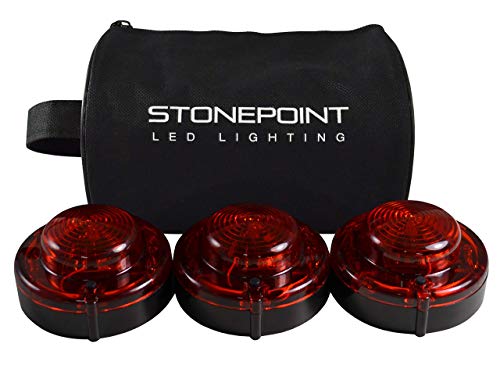
- ✓ Bright 360-degree visibility
- ✓ Compact and lightweight
- ✓ Magnetic and water-resistant
- ✕ Requires 3 AAA batteries
- ✕ Not rechargeable
| Light Visibility | 360-degree illumination |
| Run Time | 20 hours in steady mode, 60 hours in flash mode |
| LED Lifespan | 50,000 hours |
| Power Consumption | 0.5 watts per beacon |
| Battery Type | Requires three AAA alkaline batteries (not included) |
| Durability and Resistance | Crush resistant up to 6,000 pounds, water resistant |
You’re stranded on a dark, deserted road, and the last thing you want is to fumble with bulky, unreliable flares. That’s where these StonePoint LED Emergency Road Flare Kits come in clutch.
I tossed them into my backpack, and their compact size immediately stood out—small enough to slide into any compartment or glove box.
What really surprised me was the brightness. These lights give off a 360-degree glow, making your vehicle or location visible from far away, even in heavy rain or fog.
The steady mode runs for about 20 hours, so I knew I’d be covered for long waits, while the flash mode’s 60-hour runtime means they’re perfect for signaling or emergency alerts.
The magnetic base is a game-changer. I tested sticking one to the side of my metal toolbox, and it held firm—no slipping or sliding.
Plus, they’re crush resistant up to 6,000 pounds, so a passing vehicle won’t damage them. Water resistance is another plus, making them reliable in wet conditions.
Switching between flash and steady modes is simple, and the lights are super lightweight, so I didn’t feel weighed down. They come with storage bags, which helps keep everything organized in my emergency kit.
Plus, replacing the batteries is straightforward, although you do need three AAA batteries per flare (not included).
Overall, these flares are a smart upgrade from traditional strike flares. They’re safe, reusable, and dependable, perfect for anyone who wants peace of mind during roadside emergencies or outdoor adventures.
ACR ResQLink View GPS Locator Beacon Survival Kit

- ✓ Clear GPS tracking
- ✓ Bright, visible signals
- ✓ Waterproof and durable
- ✕ Expensive
- ✕ Slightly bulky
| GPS Tracking | Built-in GPS receiver with real-time location updates |
| Signal Range | Up to 30 miles (48 km) in open terrain |
| Waterproof Rating | IPX7 waterproof for immersion up to 1 meter |
| Battery Life | Approximately 24 hours of continuous operation |
| Emergency Signal Features | Bright LED strobe, visual display, and loud audible alarm |
| Durability | Shock-resistant and designed for extreme outdoor conditions |
Imagine you’re caught in a sudden storm on a remote trail, rain pounding down as you realize your phone’s signal has vanished. You reach into your backpack and pull out the ACR ResQLink View GPS Locator Beacon, feeling the sturdy weight and knowing it’s your lifeline.
This beacon instantly catches your eye with its bright screen, displaying your GPS location clearly. The glow of the signal light and the loud strobe are reassuring, especially in low visibility conditions.
It’s surprisingly compact for what it packs: GPS tracking, a visual display, and a fast rescue feature all in one device.
The built-in GPS works smoothly, showing your exact position. When you activate the device, it quickly transmits your location to rescue services.
The bright strobe and signal mirror make it easy for rescuers to find you, day or night.
The accompanying rescue light is a game-changer in emergencies—its waterproof design and intense LED make you highly visible. The Res-Q Whistle is loud enough to cut through wind and rain, attracting attention instantly.
The RapidDitch Drybag keeps your essentials dry, even if you’re splashing through puddles or crawling through wet terrain.
What really stands out is how all these features work together seamlessly. You feel confident knowing your gear is protected and your location can be pinpointed instantly.
It’s a heavy-duty kit that’s designed for real survival situations—not just a toy.
That said, the price is steep, and the device’s size might be bulky for ultralight backpackers. Still, when your safety depends on it, this kit offers peace of mind that’s hard to match.
What Are Backpacking Emergency Beacons and Why Are They Essential for Safety?
Backpacking emergency beacons are crucial safety devices designed to help outdoor enthusiasts communicate their location in emergencies.
- Personal Locator Beacons (PLBs): These devices send out distress signals via satellite to emergency services when activated.
- Satellite Messengers: These allow two-way communication and can send text messages along with GPS coordinates to designated contacts.
- GPS Trackers: These devices help track your route and can share your location with friends or family, providing peace of mind.
- Emergency Flashlights with SOS Features: Some flashlights include an SOS mode, which can be a simple yet effective way to signal for help.
- Smartphone Apps: Certain apps can turn your smartphone into an emergency beacon, provided you have a cellular or satellite connection.
Personal Locator Beacons (PLBs): These are compact, battery-operated devices that, when activated, transmit a distress signal to a network of satellites. They typically have a range of 406 MHz frequency, which is monitored by search and rescue organizations worldwide, ensuring a reliable means of alerting authorities in remote locations.
Satellite Messengers: Unlike PLBs, satellite messengers enable two-way communication, allowing users to not only send SOS signals but also exchange messages with friends or family. This feature is particularly useful for providing updates on your situation and receiving assistance without needing to rely solely on search and rescue.
GPS Trackers: These devices continuously monitor your location and can share this information with selected contacts, making it easier for others to find you if you get lost. Many GPS trackers come equipped with additional features like route logging and even fitness tracking, appealing to a wide range of outdoor enthusiasts.
Emergency Flashlights with SOS Features: These versatile tools can serve multiple purposes, providing light when needed and the ability to emit an SOS signal in emergencies. This can be particularly helpful in low-visibility situations, allowing rescue teams or other hikers to locate you quickly.
Smartphone Apps: Various applications are available that can utilize the GPS capabilities of your smartphone to act as an emergency beacon. While this option is convenient, it typically requires a cellular or satellite connection, which may not be available in all remote areas, making it a less reliable choice compared to dedicated devices.
What Features Should You Consider When Choosing a Backpacking Emergency Beacon?
When selecting a backpacking emergency beacon, it’s essential to consider several key features to ensure your safety in remote environments:
-
Signal Type: Look for beacons that use both GPS and satellite technology, ensuring global coverage. Devices that utilize 406 MHz frequencies are beneficial for search and rescue teams to pinpoint your location.
-
Battery Life: Choose a beacon with a long-lasting battery, ideally with several years of standby time. Check if it has a replaceable battery option for extended use.
-
Weight and Size: Prioritize lightweight and compact designs that can easily fit into your backpack without adding significant bulk.
-
User Interface: A straightforward interface is crucial for quickly sending distress signals in emergencies. Opt for devices with simple buttons and clear indicators.
-
Water and Dust Resistance: Look for beacons with an IP rating of at least IP67, indicating they are both waterproof and dustproof, which is essential for rugged outdoor conditions.
-
Tracking Features: Some advanced beacons offer tracking capabilities, allowing family or friends to monitor your movements, enhancing safety during longer trips.
Selecting a beacon with these features will significantly increase your chances of being rescued in an emergency.
How Crucial Is GPS Accuracy for Emergency Situations?
GPS accuracy plays a vital role in emergency situations, particularly when utilizing devices like backpacking emergency beacons to ensure timely rescue and assistance.
- Signal Precision: The accuracy of a GPS signal is crucial for pinpointing the exact location of an emergency. A precise location allows rescuers to reach the individual quickly, minimizing the risk of further danger or delay in receiving medical attention.
- Response Time: Accurate GPS coordinates can significantly reduce response times in emergencies. When the location is clear and precise, emergency services can mobilize and navigate to the site efficiently, potentially saving lives.
- Coverage Limitations: The effectiveness of GPS can be hindered by geographical obstacles such as mountains, dense forests, or urban environments. Understanding these limitations is essential for backpackers to choose the best emergency beacon that offers reliable performance even in challenging terrains.
- Technology Integration: Many modern emergency beacons integrate GPS technology with other features like two-way communication or satellite messaging. This integration enhances the ability to provide updates on the situation and coordinates, ensuring that help can be dispatched accurately and effectively.
- Battery Life and Reliability: The reliability of GPS in emergency beacons is not only about accuracy but also about how long the device can maintain a signal. A beacon with a long battery life and dependable GPS accuracy ensures that it can function effectively throughout an extended emergency situation.
What Role Does Battery Life Play in Beacon Reliability?
Battery life is a crucial factor that significantly impacts the reliability of a backpacking emergency beacon.
- Duration of Use: The battery life of a beacon determines how long it can operate during an emergency situation. A beacon with a longer battery life can provide peace of mind for backpackers, ensuring that they remain protected for extended periods, especially in remote areas where help may take time to arrive.
- Signal Strength: The performance of the beacon can also be affected by the condition of its battery. A low battery may lead to weak signal transmission, making it difficult for rescuers to locate the beacon’s signal. This emphasizes the need for reliable battery life to ensure effective communication when it matters most.
- Battery Type: Different beacons use various types of batteries, such as lithium-ion or alkaline, which can influence longevity and reliability. Lithium-ion batteries generally provide longer life and are more efficient in cold temperatures, making them more suitable for backpacking in harsh environments compared to alkaline batteries, which may deplete faster.
- Maintenance and Replacement: Understanding battery life also involves regular maintenance and timely replacement of batteries to ensure optimal performance. Backpackers should be aware of the expiration dates and check their emergency beacons before each trip to avoid being caught with a non-functional device due to drained batteries.
- Charging Options: Some modern beacons come with rechargeable batteries, allowing users to charge them conveniently before heading out. This feature can enhance reliability since backpackers can ensure their device is fully powered, reducing the risk of battery-related failures during critical moments.
How Do Communication Options Improve Emergency Response?
Communication options significantly enhance emergency response by ensuring that individuals can quickly and effectively signal for help in critical situations.
- Satellite Beacons: These devices use satellite networks to send distress signals, which can be received anywhere in the world. They are ideal for remote locations where cellular signals are weak or nonexistent, providing a reliable means to reach emergency services.
- Personal Locator Beacons (PLBs): PLBs are compact devices that, when activated, transmit a unique distress signal along with GPS coordinates to search and rescue organizations. They are battery-operated and can function in harsh environments, making them a vital tool for backpackers in emergencies.
- Smartphone Apps: Various apps can be used to send SOS signals or share location data with emergency contacts. While they rely on cellular or Wi-Fi connectivity, they can be useful in areas with good service and can provide additional information, such as weather alerts and safety tips.
- Two-Way Radios: These devices allow for real-time communication between individuals in a group, facilitating coordination during emergencies. They are particularly useful in areas with limited cellular coverage, enabling users to stay connected and manage the situation effectively.
- Emergency Whistles: Though not electronic, whistles are a simple yet effective way to signal for help in the wilderness. They require no batteries and can be heard over long distances, making them an essential backup communication tool for backpackers.
By incorporating these communication options, backpackers can greatly enhance their safety and the likelihood of a swift response during emergencies.
What Are the Best Backpacking Emergency Beacons Currently Available?
The best backpacking emergency beacons are essential tools for safety in remote areas, providing crucial communication capabilities in emergencies.
- Garmin inReach Mini 2: This compact device offers two-way satellite messaging and an SOS feature that connects you to a 24/7 monitoring center.
- SPOT Gen4: The SPOT Gen4 provides a reliable way to send your GPS coordinates to emergency services and loved ones, even in areas without cellular coverage.
- ACR ResQLink View: This personal locator beacon includes built-in GPS and a unique viewable display that shows you the status of your distress signal.
- Bivy Stick: This beacon allows for two-way messaging and SOS capabilities, connecting with a mobile app for enhanced communication during emergencies.
- Ocean Signal RescueME PLB1: A compact and lightweight personal locator beacon that activates a distress signal via satellite and is designed for extreme conditions.
The Garmin inReach Mini 2 is known for its durability and extensive satellite coverage, making it ideal for adventurers who want to stay connected no matter where they are. Its ability to send and receive messages greatly enhances safety, allowing users to inform others of their status or call for help when necessary.
The SPOT Gen4 is a popular choice among backpackers because of its straightforward functionality and long battery life. It features an SOS button that alerts emergency services with your location, providing peace of mind when exploring remote trails.
The ACR ResQLink View stands out with its display that allows users to confirm that their distress signal is being transmitted and includes GPS functionality for precise location tracking. This added feature ensures rescuers can find you more quickly in an emergency situation.
The Bivy Stick integrates with a mobile app, providing not only SOS capabilities but also the ability to send and receive text messages, making it a versatile option for those who want to stay in touch while off the grid. Its Bluetooth connectivity enhances usability and convenience for backpackers.
The Ocean Signal RescueME PLB1 is designed specifically for extreme outdoor conditions, making it a reliable choice for serious adventurers. Its compact size and robust design ensure that it can withstand harsh environments while still providing critical emergency signaling capabilities.
Why Is the Garmin inReach Mini a Leading Choice?
The Garmin inReach Mini is a leading choice for backpackers because it combines compact design, reliable satellite communication, and emergency features that are crucial for safety in remote areas.
According to a review by Outdoor Gear Lab, the inReach Mini stands out due to its two-way messaging capabilities and an SOS feature that connects users to a 24/7 monitoring center, providing peace of mind in emergencies (Outdoor Gear Lab, 2023). This capability is essential for backpackers who may venture into areas without cell service, as traditional communication methods are often unavailable.
The underlying mechanism driving the popularity of the inReach Mini lies in its use of the Iridium satellite network, which provides global coverage. This ensures that users can send messages and access emergency services regardless of their location, a critical advantage in wilderness settings where cellular networks are nonexistent. Furthermore, the device’s compact size and lightweight design make it ideal for backpacking, allowing hikers to carry it without adding significant weight to their gear (REI Co-op, 2023). This combination of functionality and portability is central to its appeal among outdoor enthusiasts who prioritize safety while minimizing pack weight.
How Does the ACR ResQLink 400 Compare to Other Beacons?
| Feature | ACR ResQLink 400 | Other Beacons |
|---|---|---|
| Price | $299 – Mid-range price for advanced safety features. | $200 – $500 – Varies widely based on functionality. |
| Features | Built-in GPS, 406 MHz signal, and buoyancy. | Varies – May lack GPS or have different signal types. |
| Battery Life | 5 years – Long-lasting with a replaceable battery. | 2-10 years – Depends on model and usage. |
| Weight | 5.4 oz – Lightweight and portable for backpacking. | 4-10 oz – Generally lightweight but varies by model. |
| Dimensions | 5.4 x 3.0 x 1.5 inches – Compact design for easy storage. | Varies – Sizes can range significantly. |
| Water Resistance | IP68 – Fully waterproof up to 10 meters. | Varies – Some models may not be waterproof. |
| Activation Method | Manual – Requires user to activate. | Varies – Some may have automatic activation features. |
| Rescue Signal Confirmation | Yes – Sends confirmation that the signal was received. | Varies – Many beacons do not confirm signal reception. |
How Can You Effectively Use a Backpacking Emergency Beacon in an Emergency?
To effectively use a backpacking emergency beacon in an emergency, it’s essential to understand its features, functionality, and proper usage.
- Understanding the Type of Beacon: Familiarize yourself with the two main types of emergency beacons: Personal Locator Beacons (PLBs) and satellite messengers. PLBs are designed for emergency situations, transmitting a distress signal to search and rescue authorities, while satellite messengers allow for two-way communication and can send pre-set messages, which can be useful for non-emergency situations.
- Pre-Trip Testing: Before embarking on your backpacking trip, ensure that your beacon is in working order by testing it according to the manufacturer’s instructions. This includes checking the battery life, signal strength, and any software updates, which are crucial for ensuring that the device will function correctly in an emergency.
- Registration: Register your emergency beacon with the relevant authorities or organizations, such as the NOAA in the U.S. This registration allows search and rescue teams to identify you and your emergency contact information in case they receive a distress signal from your device.
- Location Awareness: When using an emergency beacon, ensure you are aware of your surroundings and the closest points of interest, like trails, landmarks, or campsites. This information can help rescuers locate you more quickly when you activate the beacon.
- Activation Protocol: In an emergency, follow the proper activation protocol for your beacon, which typically involves removing a safety pin or pressing a dedicated button. Be sure to keep the beacon in a location that is easily accessible, such as a front pocket or strap on your backpack, so you can reach it quickly if needed.
- Signal Transmission: After activating the beacon, it will begin transmitting your location to emergency services via satellite. Stay in place once activated to ensure that rescuers can find you, and avoid moving unless it is necessary for your safety, as this can complicate rescue efforts.
- Post-Emergency Check: After using your emergency beacon, conduct a thorough check to assess any damage and recharge or replace the batteries as required. Additionally, report the activation to the appropriate authorities, as false alarms can divert resources from real emergencies.
What Are the Key Safety Benefits of Carrying an Emergency Beacon While Backpacking?
The key safety benefits of carrying an emergency beacon while backpacking include enhanced communication, improved location tracking, and expedited rescue efforts.
- Enhanced Communication: Emergency beacons allow backpackers to send distress signals to rescue services even in remote areas where cell phone coverage is nonexistent. This capability ensures that help can be summoned quickly in case of an emergency, providing peace of mind during outdoor adventures.
- Improved Location Tracking: Many emergency beacons are equipped with GPS technology, enabling users to transmit their exact location to rescuers. This feature significantly reduces the time it takes for search and rescue teams to find individuals in distress, as they have precise coordinates to guide them.
- Expedited Rescue Efforts: The ability to send a distress signal and provide location information can lead to faster rescue operations. This is particularly critical in life-threatening situations, such as severe injuries or sudden illnesses, where every minute counts.
- Durability and Reliability: Emergency beacons are designed to withstand harsh outdoor conditions, ensuring they function when needed most. Their robust construction means that they can endure elements like rain, snow, and extreme temperatures, making them a trustworthy safety tool for backpackers.
- Battery Life and Maintenance: Most emergency beacons have long battery lives, allowing them to remain operational for extended periods. Regular maintenance and checks are necessary to ensure that the device is ready for use, which adds to the overall reliability of the beacon in emergencies.